AI: From Curiosity to Capacity-Builder
This article was originally written for and published by the Thomson Reuters Institute. You can read the original here.
Government legal departments are facing an all-too-familiar problem: more work, more complexity, and the same number of staff to do the job, according to the Thomson Reuters Institute’s 2026 Government Legal Department Report, which captures the insights from 200 government legal department professionals at varying levels.
Threaded through these insights, some clear trends emerged. For example, technology — especially AI and other advanced tools — is increasingly serving as an extension of staff, expanding agencies’ capacity to manage rising workflow demands.
Increasing pressures across all levels
More than one-third of respondents report that their workload increased by more than 10% in the past year, with many handling between 21 and 50 legal matters per week. At the same time, workloads are becoming more complex, with more than one-third of respondents saying that more than half of the legal issues they face are complex, which is particularly notable at the state and federal levels.
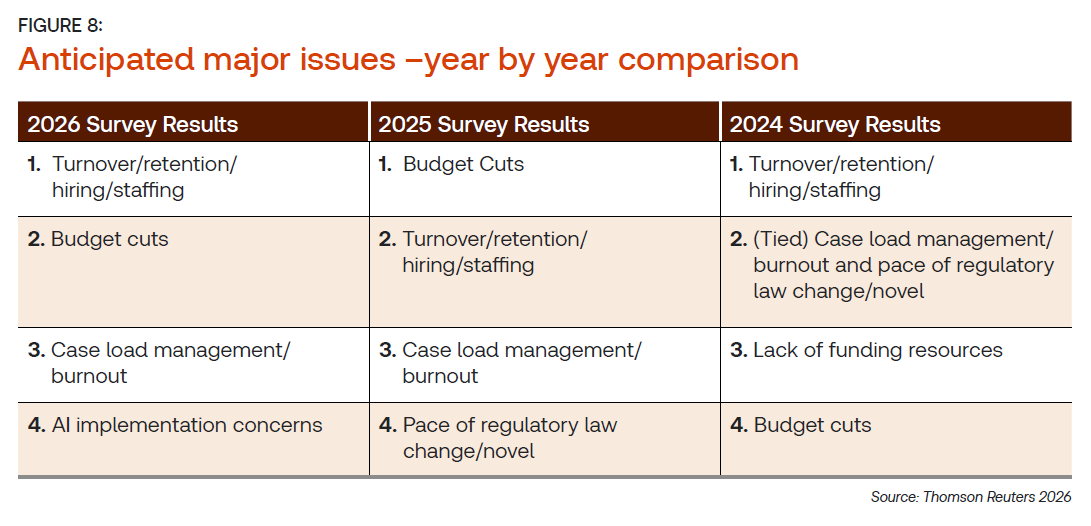
Staffing shortages, a top concern in recent years, continue to persist. Three-quarters of respondents say their agencies experienced staffing shortages over the past two years, and almost two-thirds say they anticipate shortages into 2027.
Indeed, despite an increase in complexity and workload, attorney staffing levels have stayed the same for almost 40% of agencies, the report shows. And at the federal and state level, departments were more likely to have experienced a reduction of more than 10% of their staff.
AI adoption skyrockets, making governance more necessary than ever
More than one-quarter of respondents say their agency or department is now using AI tools, up from a meager 5% last year, with this increase taking hold at the federal and state level much more quickly. Among the different groups of respondents, one-third of federal and state government legal professionals report using AI tools compared to just 19% of those at county and city departments. Resistance to AI is diminishing, too; however, more than one-third of county and city legal departments still report having no plans to use AI.
Optimism toward AI is rising alongside implementation, the report shows. More individuals at the federal and state level feel optimistic than pessimistic about AI technology, which is an inversion of last year’s sentiment. Among county and city legal professionals, pessimism still remains more common. Among all respondents, confidential data exposure remains the top evaluation criterion when assessing these advanced tools.
The report underscores that this all points to a need for the establishment of strong governance models before adoption. Nearly two-thirds of government agencies and departments have an AI use policy in place or are developing one, respondents say. However, 1-in-5 departments and agencies are still without an AI use policy, risking unofficial use of prohibited AI tools.
Those agencies hesitant to implement AI technology are encouraged to view AI technology as a way to increase staff capacity amid flat staffing, rising workloads, and growing matter complexity. AI tools can help reduce strain on employees, contributing to better-managed workloads while reducing employee burnout. When appropriately vetted, however, AI technologies can reduce administrative burdens, increase legal research efficiency, and help those organizations facing trying to manage more work with the same staffing levels.
An actionable path forward
As the report makes clear, AI is no longer a future challenge; rather, it’s a present reality in a rising percentage of government legal departments. Indeed, the report outlines ways departments and agencies can move forward in this space, by beginning with lower-risk foundational tools like legal research and case management systems; and then investing time in developing thoughtful AI use policies and evaluation protocols. With responsible staff training and a thoughtful evaluation process, AI technologies can protect the valuable time and work-life balance of government legal professionals.
Increasing workloads are not optional for government legal departments, but how department leaders empower their staff to manage these workloads is becoming the differentiator.
Download a full copy of the 2026 Government Legal Department Report here.