Book Review: Many Unhappy Returns by Charles Rossotti
For our fourth book of 2026, our Bettering Communities Book Club read our thirteenth book - Many Unhappy Returns: One Man’s Quest to Turn Around the Most Unpopular Organization in America.
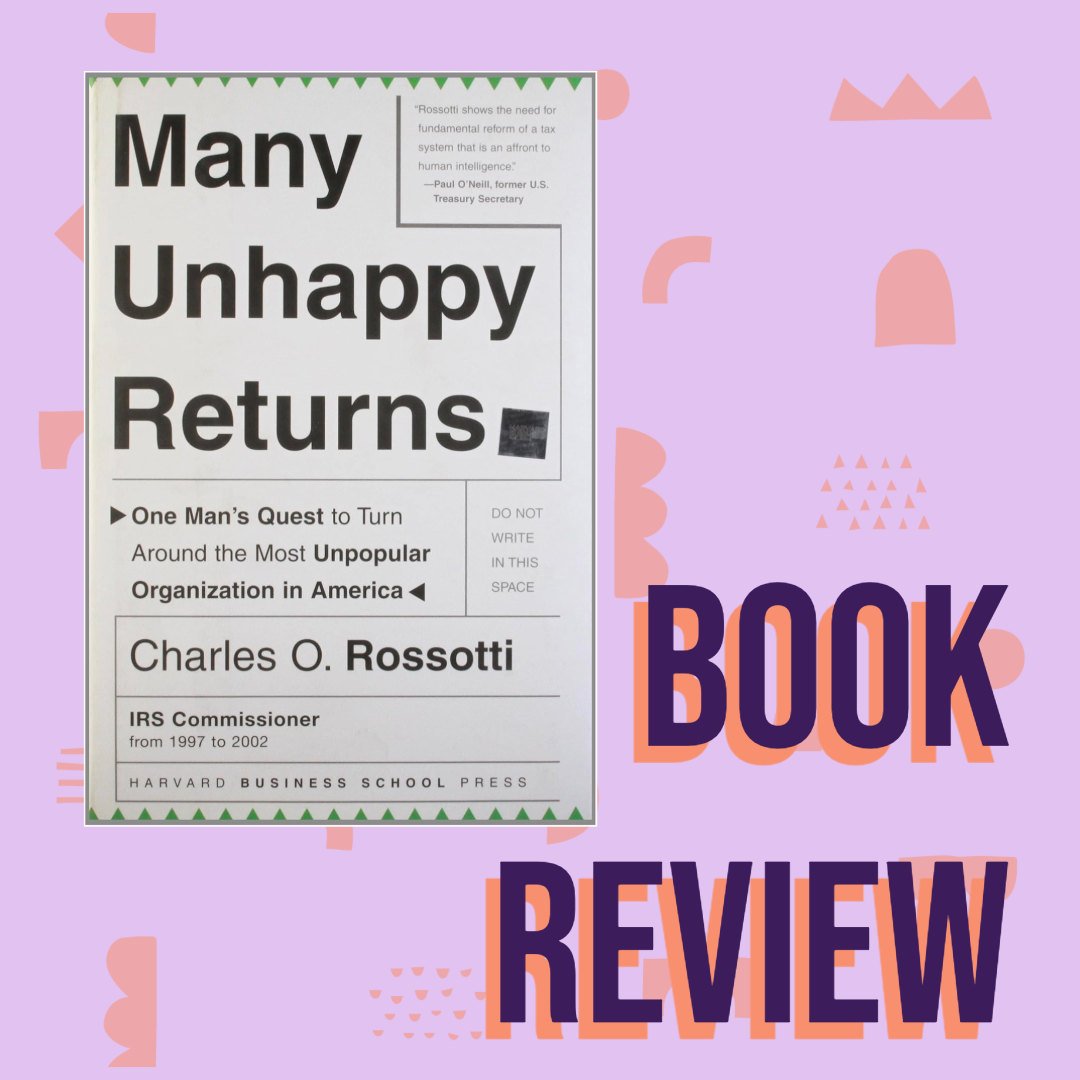
Our Reactions to the Book
Our book club didn’t expect a memoir about the Internal Revenue Service to be a page‑turner — but Many Unhappy Returns surprised all of us. Rossotti’s writing is accessible, engaging, and grounded enough in tax administration that you understand the stakes, yet never so technical that you need a CPA to follow along. More importantly, the book offers cultural and organizational lessons that apply far beyond the IRS.
Rossotti’s story centers on the late 1990s, a period when most of us weren’t paying close attention to the IRS. At the time, the agency was receiving intense public criticism for practices that incentivized aggressive enforcement and eroded public trust. Deeply unpopular and culturally adrift, the IRS needed a turnaround — and Rossotti, pulled from the private sector, stepped into one of the most challenging public leadership roles imaginable.
Even though none of us personally interacted with the IRS during that specific era, the anecdotes felt familiar. We’ve all heard stories of confusing notices, long wait times, or intimidating audits. Rossotti’s memoir helps explain how those experiences were symptoms of deeper cultural and structural problems.
What resonated with our group
The first half of the book is a masterclass in organizational diagnosis.
Rossotti’s breakdown of the IRS’s issues — siloed divisions, outdated systems, unclear expectations, and a culture shaped more by fear than mission — felt eerily similar to patterns we see across government today. The diagnostic portion was the most applicable to our own work in city departments, public works, permitting, and community development.
Accountability without blame.
Rossotti models a version of accountability that is shared, humane, and mission‑aligned. He doesn’t weaponize accountability; he uses it to rebuild trust.
Clarity as a morale booster.
When IRS staff finally understood what success looked like, morale didn’t just improve — it stabilized. Clarity is culture.
Systems shape behavior.
Outdated processes weren’t just inefficient; they actively undermined trust, performance, and customer experience. Rossotti’s reforms show how systems either reinforce or erode culture.
What didn’t translate cleanly to today…
A private‑sector leader entering a federal agency without intending to fire everyone.
This felt almost quaint compared to more recent examples of high‑profile outsiders entering public institutions with scorched‑earth intentions. (We referenced the 2025 DOGE effort as a contrast — a moment that shaped our expectations of what “outsider leadership” looks like today.)

Bipartisan support for common‑sense reforms.
Rossotti’s era included moments of near‑unanimous bipartisan agreement on IRS modernization. Today, politics are more polarized, career public servants are often scapegoated, and the existential question has shifted from “Does this organization function well?” to “Should it exist at all?”
The book’s historical context is important, but it also highlights how dramatically the political landscape has changed. Readers should confirm historical details with trusted sources, but Rossotti’s account underscores how rare bipartisan administrative reform has become.
The Executive Branch as the Unspoken Barrier
One of the most striking themes — and one our group discussed at length — was Rossotti’s portrayal of the Executive Branch as the primary obstacle to IRS reform. From his perspective, the tail end of the Clinton Administration resisted long‑term systems investment and used the budgeting process to constrain the agency, even when Congress supported modernization.
Rossotti’s framing is his own, but it raises important questions about how executive priorities shape public institutions. It also reminds us that public approval, political optics, and short‑term wins often overshadow long‑term operational needs.
The human side of taxes
Is it shocking that people don’t want to pay their taxes? No.
Newsworthy? Not really.
Depressing? Kinda.
The book reveals how heavily the U.S. tax system relies on honesty and voluntary compliance — and how many Americans are willing to take risks to reduce their tax liability. Our group reflected on how federal taxes feel distant, while local taxes feel tangible because we see the services every day.
We also discussed how tax burden feels different depending on employment type. Traditional employment hides the pain through automatic withholding; self‑employment makes the cost visible, immediate, and often stressful.
Trust in institutions has declined dramatically, but we need them more than ever
Across multiple books, our group has noticed a recurring theme: declining trust in institutions. Yet mission‑driven public and quasi‑public organizations often deliver higher‑quality customer care precisely because they are not profit‑motivated.
Still, the public wants:
better customer experiences
… without increasing public budgets
more hands‑on service
… with fewer hands to do the work
Our desires and our fiscal appetite are misaligned.
We also discussed how government has absorbed responsibilities once held by faith‑based institutions. As church membership declines, people increasingly look to local government for individualized support — even though government is designed for collective service, not individualized care.
This tension shows up everywhere: in schools, hospitals, permitting offices, and yes, the IRS.
Our final thoughts
We discussed the complex relationship between patient outcomes and the resources invested in that industry. The aging services field in particular has a projected workforce shortage as the baby boomer generation continues to age. This is a field that many of us care deeply about (as we’ve had family members or loved ones in a health care facility), but the work is undervalued and undercompensated to the point that we rely heavily on an immigrant workforce to fill these vacancies in the U.S. A misalignment between desires and our fiscal appetite.
Brookings (A direct care worker visa policy to support the aging US population)
LeadingAge (Foreign-born workforce and aging services)
Other reads on the subject of community institutions and declining trust:
A Time to Build by Yuval Levin
Alienated America by Timothy P. Carney